
20: A Retrospective

2025 is wrapping up and as many of you know, not only is it the UN’s “International Year of the Co-op” but it’s also Wraith’s 20th anniversary! 20 years. Wow. Twenty… Years.
You know, any time an anniversary of any kind happens, it’s easy to get wrapped up in the nostalgia of it all. The successes, the failures, the friends you’ve made, and those you’ve lost along the way. There is so much I want to tell you all here. So much I want to lay out on the page. It’s actually kind of hard to write.
20. Years.
The year we started gave us Mario Kart DS, Guitar Hero, and Resident Evil 4.
It hardly seems real.
We’ve spent 20 years doing the thing that we love more than anything in the world; 20 years of mastering our craft.
My back hurts.
I’m not quite sure what this blog post is. I know what notes I want to hit, but I’m not sure in what order. Is this a biography? A manifesto? A confessional? Let’s find out together, shall we? I’ll actually level with you all. I started writing this at the start of the year with the plan of releasing it on our “official” anniversary date. Cut to now and it’s one ̶w̶e̶e̶k̶ day before the end of the year and I still don’t know if I’ll be able to release this. After all, I did do something like this already back in 2019, but this is intended to be a bit more "complete".
We’ll start at the beginning, as most stories seem to. But that’s just what this is. A story. As Stan Lee once said “I’ve told this story so often, it might even be true.” Maybe next time I tell it, it will be a little different. We are, after all, looking at it from my perspective.
Memories are a strange thing. They say that you’re never actually remembering an event, but remembering the last time you remembered it. It changes; gets fuzzy. I, famously, have never been accused of having perfect recall in the first place.
I’m not going to be able to get to everything but I sure can try… and try to recall them as accurately as I can; for whatever that’s worth.
Heck, most “official” sources (like our Wikipedia article that literally got deleted earlier this year between edits of this post) say we were founded in March 2005, but I don’t think that’s right, even. It was more likely in the fall. I simply can’t remember the date we were actually founded.
Like I said, this will be a very Jay-centered perspective. A perspective that a lot of you may already be familiar with. I write most of the blogs, give most of the talks at events, get interviewed the most by the press. Who knows, maybe I can get some of the rest of the team to write something (edit: that would be a no). However, as you can probably tell, most of us don’t really want to sit down and write an essay about our time in gamedev. I can’t promise anything, but I’ll ask them.
Anyway.
Indulge me a bit, as I talk about our history; my history. What we have done, why we did it, and where we are going. How I got started with game development and how I formed Wraith. How it became bigger than me and more than I could have ever dreamed.
I distinctly remember being 8, 9, or 10. One of those formative ages. I think on most retellings I say “9”. I had recently gotten a Super Nintendo for Christmas. Now, for some of you, that already feels like I’ve stepped in it. Most people who know anything about me know that I’m 3̶4̶ 35 now (yes, that’s how long this has taken to write). Wouldn’t that put me firmly at the N64 age?
Well, kinda. See, my mom didn’t want me to have a game console. My grandmother wanted to get herself an N64, however, and didn’t have need for her SNES. She worked out a deal with my mom to give me her old SNES as a Christmas gift. Works for me!
At the time, all I had was a hand-me-down Windows 3.1 PC in my room where I played DOS games like “Jill of the Jungle” and the first 2D “Duke Nukum” (not a typo, it was called that for a time in the 90s). My very own Super Nintendo was something else, though. I fell in love with all things gaming and all things Nintendo. After all, in the 90s, weren’t they one and the same?
Up until that point I wanted to be an astronaut or a scientist of some kind when I grew up. My mother hoped I would be a fine artist as she had pursued but stopped when she had my older brother. I told her that I knew what I wanted to do when I grew up, at age 9 or so. I said I “wanted to make video games”. She told me that it “wasn’t a real job”. I rebutted that “at $70 somebody was getting paid somewhere”.
That’s how I know I’m an unreliable narrator. I remember that retort. A hard, core memory. But we all know there was no way 9-year-old me, no matter how precocious, was saying something that funny or on point. Despite remembering it, I know that it was very unlikely.
That was 26 years ago, after all.
But “make games” I did.
I spent a lot of my time making games as a kid. I couldn’t just “play pretend” with my friends. No, when we “played Dragonball Z” I would dress up in full costume and I had made these cards with different powers we could have. Each card said how much damage it would do and how much the power “cost”. We would have, like, 100 points to spend and, say, a “Kamehameha Wave” cost 30 points, but a “Solar Flare” only cost 15. We would then draft these cards, basically, and act out our battles as real (mock) fighting using only the moves we drafted.
I somehow managed to gamify our childhood games. Worse, I “invented” the LARP for us.
I made several board and card games, too. I would print trading card game cards off the printer, or draw them onto index cards. A hundred little Pokémon or Yu-Gi-Oh! knockoffs. Don’t get me started on the amount of “almost chess or checkers” I came up with. There was one abstract strategy game I made called “Arc” that was so popular that the school had to ban it. Good times.
I actually designed a little sport, too. You know those big cage-style jungle gyms? Well, in “Cageball” you would have players inside of the cage throwing one of the “PG-13” stamped red rubber dodgeballs and, if it left the cage, whoever it touched last was “out”. Last man standing. That one became popular enough that some of the moms in the community made us t-shirts and even other schools began playing. There was conversation about turning it into a “real thing” but a couple kids got injured and it was shut down. Oh what could have been.
That’s not even mentioning how I accidentally re-invented D&D after watching the Dexter’s Lab episode “D & DD” and raiding my mom’s board game collection to get an approximation of the dice and miniatures I needed to recreate it. I had no idea that D&D was a real game, I just thought what Dexter and his friends were playing looked cool. This, of course, comes only a couple of years before the Scholastic Book Club introduced me to my first real TTRPG, “Star Wars Episode 1 Adventures”. Put a pin in D&D, though. It comes back in a big way shortly.

A screenshot from the Dexter’s Lab episode “D&DD”
From making board games in Excel to playing in the level editors of countless games, to working with a group of friends to try and make a Pokemon/Digimon knock-off called, unoriginally “Gigamon” (Hi Zach and Ryan… I know you’re not reading this) making crappy little games was in my blood. I wanted nothing more than to turn this idea into a real career when I grew up. Or, even better, be the kid genius whose game-making empire disrupted a whole industry. Oh the folly of youth. I’m glad I dreamed big, though. After all, “Shoot for the moon. Even if you miss, you’ll land among the stars.”
I was convinced, though, that that was exactly what I was going to do. That somehow I was “the special”. Man, you’ve gotta love the hubris!
But that was so much of my late elementary school and middle school life. Make little games or daydream about games I was going to make. I remember the number of game manuals and magazines I cut up to make fake manuals for games I was “going to make”. I was absolutely obsessed!
However, things changed (just a bit) when I entered high school. There, I met Joe and Raymond.
See, I was an awkward kid. Spoke way too fast about things way over my own head and pivoted in countless directions. Couple that with hyperfixation on things that interested me to the detriment of anything (or anyone) that didn’t, and a cocksure attitude that I was always the most intelligent person in any room, and you can probably see why I was bullied a lot in school.
Now, that’s not to say I had trouble making friends. I didn’t. I had a lot of friends (in hindsight, way more than I thought I had at the time). However, I wasn’t the best kid to get along with, that’s for sure… and this was before the emo phase, too!
However, it didn’t help that I moved around a lot with my mom. When I did make friends in one place, we were off to the next rather quickly. Maybe if we had stayed put, it would have been easier, but between my mom’s career and her absolute terror that I would be a social pariah if I even started to get off on a bad foot at a new school meant she’d whisk us away long before I could ever really establish roots. That did mean, however, when I did have friends, they were fast friends and these relationships were very intense! Ride or die in 3 weeks or your money back.
Joe, Raymond and I became friends over the course of a few days my freshman year of high school. Turns out we had some things in common! A love for anime, games, Bayblade, Star Wars, among other things. Additionally, we decided to do two things together: Learn to play D&D… and start a game company!
Now, I’ll be the first to say that “Mind’s Eye Games” wasn’t much of a game company. While I had a heavy art background growing up until that point, I didn’t know anything about programming or design. Neither did they. Instead, I ended up checking out dozens of programming books (and D&D books) from our local library and tried desperately to figure out how to do it. I…. did not succeed.
We did, however, whip up a cool GeoCities website for all the games we were going to make and have countless multi-hour-long sessions designing them together on paper while trying to figure out just how to get those ideas on the screen. We were basically a little game design club at this point, we just didn’t know it yet.

The first Wraith Games logo from 2006… we no longer have the “Mind’s Eye Games” logo
Well, as fate would have it, while learning to play D&D, I stumbled upon the art for the Wraith in the 3.X Monster Manual. It was so cool and, being a LotR fan, I advocated we change our name… and the rest, as they say, is history. We changed the GeoCities site and BOOM! “Wraith Games” was officially born. However, we still didn’t have anything to show for it. We were just a name and a web page, not really making games at all.

The 3.X D&D Wraith from the Monster Manual
That would change when Joe and I were out at EB Games (pre-Game Stop merger). There she was, sitting on the bargain shelf… “EB WORLDS”.
I have a strong feeling that absolutely none of you know what EB Worlds is. EB Worlds is/was/is a version of the hobby game development software (engine?) “Stagecast” that was distributed exclusively by EB Games. Got it? No, of course not. None of you know what Stagecast was either! Stagecast was a child-friendly game engine (engine!) meant to teach kids how to make games. It was very similar to YoYo Games’ Game Maker (it used to be 2 words) of the time.

My old copy of EB Worlds
Now, I know what you’re thinking: GameMaker is a pretty nice piece of software. Tons of great indies are made in GameMaker. Well, it’s not that easy. Back in 2005, Game Maker was, well, not very, let’s say, “robust”. GameMaker now, though, is quite nice! For another comparison, I’d say it was like a much weaker version of Stencyl, Construct 1, or Multimedia Fusion (all tools we would later pick up and try to use). Very rough stuff. However, it would really begin us on our path to actually making video games!
During this time, we made what would (in)famously be called our “50 Terrible Prototypes”. Starting with an awful (ok, they were all awful) clone of Space Invaders called “Operation Roswell”. Then a Frogger clone called “Chicken Crossing”. The third game, however, was Collapsus. We’ll jump back there in a sec. During this time we made our own Arkanoid, Pole Position, Mario, games about kung-fu stick men in 1940’s New York, and one about flying wolves fighting ghosts in ancient Japan… and so many “sequels” to those crappy prototypes all made game jam-style with only a handful of additional content.

The 2nd “better” version of Operation Roswell. Yeah, that’s an Arwing from Star Fox alright
Every single one of them uploaded lovingly to our GeoCities page and now lost to time. That’s also not to mention the CafePress store where we sold our first merch!
Cutting back to the Collapsus prototype (and the later “Collapsus Gold” which featured a timed mode and 4 whole difficulties… WOWZERS!), that was initially a present for my mom. She was big into Bejeweled at the time and since I hadn’t really watched her play (and since YouTube had just been founded) I tried to make my own version for her with zero clue what I was making. I had played Tetris, though, and borrowed a lot from that favorite of mine. One of the big issues is that I didn’t realize that in Bejeweled, you “swapped” blocks. I made it so 1 click eliminated the block instead. With that obviously being way too easy, I added the resource mechanic where you spend a resource to remove a block and making lines get some back. Pretty simple. The rotation mechanic came much later.

2006 Collapsus prototype
Well, my mom didn’t like it very much. She said it “hurt her eyes”. I was devastated and shelved the game for a few years. We’ll pick back up there in a bit.
After making most of those little prototypes, with limited input from the “team” (some of whom were getting bored with all this anyway), I ditched Stagecast for RPG Maker, then Adventure Maker (which made PSP games), BYOND (which made 2D MMORPGs), Wintermute (for point & click adventure games), and then settled on FPS Creator where I would stay for a couple of years.
I actually like FPS Creator quite a lot. However, in order to get it to do anything I wanted I bought a ton of assets, learned its in-engine scripting and shader languages, and even paid people in the FPSC modding scene to mod-in full features I wanted (the engine was written in a programming language called "Dark Basic", one which I, nor anybody I knew, well, knew) .

My old copy of FPS Creator
During this time, we lost both Joe and Raymond but picked up Thorne (who would very quickly become my best friend and, of course, stay with Wraith to this day... and even officiate Kristy's and my wedding) and a few others (like Steven L, Adam J, Bill, Danelle, Brennan, Montana, Dennis, Michael, Brad, Aaron, Eli, Craig, and Davy…who would not).
That started us on the path to make the unfortunately named Wolfenstein-like “Ubermench”: a game where you played a failed Nazi experiment to create a super soldier, instead making some flavor of Frankenstein’s monster who, once rescued and rehabilitated by the Allies, dedicated himself to eliminating the 3rd Reich.
Later, we would start the equally unfortunately named “Project Zion”, a Doom 3-like (though it ended up being more like Dead Space meets Amnesia but bad… 2 games that wouldn’t come out for years later). In PZ you are a scientist on a colony ship leaving behind a doomed earth for a lush “Class M” planet that the united human government had named “Zion” (the Promised Land). However, you are awoken part-way through the journey; thrown out of cryosleep to find your fellow crew were woken up months before and are nowhere to be found and your ship is stranded in space, wildly off course, using emergency power, and lacking comms back to Earth. You explore the “empty” ship and read logs to figure out what happened, solve lock puzzles (so many lock puzzles), restore ship power, and ultimately find that an alien virus has turned the rest of the crew into zombies (original, I know) that you must dispatch! Just… woof.
PZ was, in my mind at the time, “the one”. I submitted it to a publisher who wrote back with a very kind rejection letter. I was so upset, but looking back, the game was hot garbage. However, I did learn some things.

PZ Screenshot
Also at that point, for several months I worked on a Halo-inspired online shooter called “FTW (Frag the Week) Online”. It was surprisingly well received with our playtest groups, but the limits of FPSC’s multiplayer engine left it dead in the water after reaching some critical roadblocks.
Around this time, I left art school and moved into my first place. After a rough break-up, I went to a convention where I ended up flirting with Kristy, the woman I would eventually marry. I remember saying something like “hey baby, I make video games” (though I’m told that whatever I had actually said was not quite that cheesy). She asked me what I had made and I responded with “nothing you’ve heard of, they’re all pretty bad”.
After a few dates, I would show her Collapsus, which she encouraged me to continue working on. At the time, I declined. She, however, would not give up on the game. I just didn’t know it yet. In fact, to this day we make jokes that she fell in love with Collapsus first and then with me.

Kristy and I when we started dating
Then, later still, she moved in with me. I was working on a first-person point & click adventure game called “From The Case Files of Sara McCathy”, where you played an Agatha Christie-style protagonist solving a murder in a 1920’s mansion. It was very boring. While testing the physics, Kristy, my brother Cody, and I started throwing chairs around (in the game, guys) and realized the physics engine was way more fun than the adventure game.
Portal had just come out and we pivoted hard to making a game where you turned off gravity to solve puzzles. Lots of tractor beams, floor switches, repulsors, the whole nine yards. Now, while we were all playing a lot of Portal at the time, if you had asked me back then, I would not have realized we were kinda ripping it off. I thought the idea was wholly original.

Early Physix Screenshot circa 2009
That game would be called “Physix” and would take up the next couple years of my life. Pivoting to Physix couldn’t have come at a better time, either, as we were showcasing our game at our first-ever convention as Wraith: “A&G (Animation & Gaming) Ohio”!
A&G was a success! People loved the demo. In fact, it was such a success for us, we would go back twice more. That’s also where we met Glenn, who would later become our primary musician!

Erik Farris, me, and voice actors Chris Patton & DC Douglas at A&G Ohio signing autographs
Anyway, at that time, we saw that GamePro Magazine (god I’m old) was offering to publish 10 indie games (a new term as this was 2009) under their “Game Pro Labs” initiative. They had submissions from around the US and UK. We were told there may have been as many as 10k other dev teams vying for the contracts. Luckily for us, it turns out they loved the demo, too! We were now in with a big-time publisher!
Sadly, by the end of the next year, Game Pro Magazine had only one game published before the magazine went bankrupt and closed its doors for good (with Labs along with it).
We then submitted to another publisher, Blitz 1Up.
Unfortunately, while we were finalizing our deal with them, they, too, went belly up. We felt cursed.

Late Physix Screenshot circa 2011
We briefly tried moving over to Leadwerks, and later XNA, but also spent about half a year trying to port Physix over to Torque, before it would also end up dying as well. We also messed around with a racing game idea for Torque, too, but it never really went anywhere.
That didn’t stop us, though. Kristy and I moved house and began getting back to it. We picked up Eric, Rob, Geoff, Kyle F, Kyle S, LJ, Rachel, Camille, and Dante. None of whom are with us today (or even lasting through this past decade).
With the death of Game Pro, Blitz, and Torque, we got the core team of Geoff, Kyle S, and Dante working on programming Physix from the ground up in the newly free Unity engine with Eric and Camille doing the writing. Dante would peel off to work on a remake of one of our 50 Terrible Prototypes, “Fly Guy”, which became our first “real” release on Kongregate in 2011 before re-joining for work on Physix.

The FlyGuy Main Menu
Geoff, Kyle, and Dante were struggling with Unity at the time and wanted to move over to a smaller project that we could knock out in a few months (ha) to cut their teeth. It was Kristy who pointed to my old project Collapsus (a game they didn’t know about) to revive and get familiar with Unity. With Kristy’s well-known love for the old prototype, it makes a lot of sense that she would be the major force in convincing the programming team to pick it up. After all, it’s such a small game… it couldn’t take that long, right?
Dante would keep working on Physix trying to figure it out while Eric and Camille would work on writing it. However, I would need help with the art and game design as I would also be working on Collapsus. That’s where an old friend would reappear in my life.

The process of porting Physix to Unity
Back in high school, Brennan, a friend of mine (at the time) and part of early Wraith introduced me to Stevie Dorgan, a cool loner who worked in Flash making edgy games for Newgrounds. I was enamored by her style and would do anything to be her friend. However, due to a misunderstanding, she never ended up joining with Wraith.
Well, as we were working on Physix, she was between jobs and wanted to see if I was still making games. She wanted to join up!
We met at a Taco Bell for an interview (a terrible practice that was a tradition from when I hired Geoff and later Kyle). Surprisingly, though, while it came awfully close, it didn’t scare her off. We gained a Stevie!
Now, during this time, we lost Rachel, Dante, Rob, LJ, and Kyle F. This wasn’t unusual because, at this point, all of us were doing this very part-time. Some people moved, others got busier jobs, some left to take care of family, others got married or had kids. Honestly, being an indie isn’t the most stable life, especially so early into it. It’s hard to raise a family or buy a house when you’re staying up all night working on a game that may never sell while subsisting on ramen and energy drinks because it’s all you can afford. This was not a great way to live and I’m amazed that people stayed as long as they did. It would be many years before we were actually a stable company.
Did I mention that we’re a zero crunch studio now? I’m sure there’s no particular reason we adopted that policy, right?
Kristy and I were preparing to move yet again and, at the request of Geoff, Kyle S., and Stevie, we also got an office space so we didn’t have to work out of my living room anymore. Things were looking up! We even picked up Geoff’s girlfriend Julie and friend Jon as two new programmers.

Collapsus in Corona SDK circa 2011 – 2014
I will interject at this time to also mention that, despite Collapsus being a project to learn Unity on, Collapsus development shifted to the unfortunately named (and now defunct) Corona SDK for, like, a year, and then back to Unity. This is not to mention that they already couldn’t use my previous code either. I… still don’t know why the programmers decided to do this, as it meant starting over again from scratch (something that would continue as a bit of a theme). At least they failed quickly and didn’t need to restart code that had taken years of work. Ha. Ha. That would be silly (stick a pin in that for now).
Our little office was around 200 sq/ft or so in The Hamilton Mill, a small business development center here in Hamilton. When I was in art school, an instructor of mine mentioned that after graduation I should reach out to them (they were called the BizTech Center at the time). Just a few years after she suggested that, that’s exactly what we did.

Working in the first one-room studio space, pre-remodel
Our first office space. WOW! Except Stevie insisted we call it a “studio” space, which we still do to this day. Still, a HUGE step! Studio 1.0 at The Hamilton Mill. This was also the time we filed our official LLC paperwork with the state. Wraith was a “real” company at last!
Speaking of Stevie, with her background in branding, she created new logos and brand colors for us to vote on! The new logo and purple/goldenrod color scheme and skull/ghost mascot “Yorick” you see? All Stevie! We went from using red and black with a Ghastly Panic logo, to a right-proper brand identity in less than a week. A new studio, new brand, and a registered LLC? Everything looked like it was coming up Wraith.

The 2009 – 2015 Wraith logo

Some mockups of the current Wraith logo
It wasn’t all sunshine, though. In the span of just one week, Geoff and Julie both got offered killer jobs as programmers elsewhere. Kyle S’ girlfriend insisted he get a “real” job, and Jon joined a think tank. We lost all 4 of our programmers at the same time. Collapsus and Physix were dead in the water. I don’t blame them, though. However, it is a bit ironic since, just a handful of months before, the programmers were the ones who wanted us to get an office in the first place, but what can you do?
At the time, morale was at an all-time low despite all the positive changes. Stevie, however, had an idea. We should hit the convention scene hard and heavy. Show people what we’d been working on, get our new brand out there, and maybe even find a new programmer or two to pick up where the others left off.
That’s what led us to OGDE (now GDEX). It was, I believe, their second year of operation, and Stevie had gone the year before with another team (Gear5, now defunct) she had been working with. The trip was a success! We made new friends, got players’ hands on Collapsus, and even met the AbleGamers for the first time, guiding us on our path to accessible development.

Showing off Collapsus at OGDE!
However, cohesion was not great. Half of the team was butting heads with the other half. We spent a good chunk of the event fighting each other, having split into two teams down ideological lines. We thought this could have ended us. Thankfully it didn’t!
When we got back, we decided to start getting the studio space looking the way we wanted it. Partially as a teambuilding exercise, partly as a way to move past the loss of the programmers, and partly so we didn’t have to work in a cramped, beige box anymore. We’re talking paint, furniture, equipment… the whole nine yards.
It took months, and many long nights, but we managed to get it looking how we wanted it. It’s pretty funny because, ultimately, while it took a lot out of us in terms of labor and funds, it was actually so much less than the work/money we’d put into later studio spaces and renovations. It really felt like a huge deal at the time, though.

The final version of the first room of Studio 1.0
All we needed still was new floors and a mural! Both would come later, though. Next up, we were joined by Lance, Natalie (neither of whom would last to the current roster) and Adam Brown! We would also pick up our first intern, Chad, at this time.
We took this time to really buckle down on visiting events like Pandoracon, COSI After Dark, Game Masters: The Exhibition, LexPlay, VectorConf, and UDcon. It was at UDcon that we would meet our buddy Griffin Parker for the first time, as well as Adam from Galatune & Ben from Bellum. Then, at Vector, we met our friends with RunJumpDev and also, Mark, our lead programmer for the next few years!

Showing off Collapsus at VectorConf
During the gap, Kristy actually ended up picking up programming but realized she actually wasn’t a big fan of it afterall. With the addition of Mark, however, proper development for Collapsus could once again get back on track.
However, Mark was unable to use any of the previous code that Geoff, Kyle, Julie, Jon, or even Kristy had done. He had to start from scratch.

Mark’s version of Collapsus in Unity circa 2017
With just one programmer (for the time being), more artists than we knew what to do with, and staff writers for Physix, a game which wasn’t really going anywhere, we put Physix on indefinite hiatus and, with it paused, Camille took her leave, followed shortly by Eric.
Stevie, however, was working hard on a mascot for Collapsus… “Leon the Chameleon”, later voiced by our friend Griffin! Not going to lie, the design process for Leon was a ROUGH one. It pushed Stevie’s and my working relationship (and, honestly, friendship) to the limits.
However, we came out stronger. In fact, spoilers, I was the Person of Honour at her wedding earlier this year! When giving my speech, I was even allowed to make some references to some of our more famous blowouts. It was so long ago in the rearview mirror that we joke about them now.

Stevie’s first Leon sketch
Also at this time, we had those new studio floors installed. Unfortunately, the company that installed them didn’t level out the subfloor first, so we had to rip them up and do them ourselves. That, however, was nothing compared to the mural issue.

Working on re-installing the floors
Lance designed us a beautiful mural celebrating Wraith’s past and our planned projects for the future. He, along with Eric and I, sketched it out onto our wall.

The digital mockup of the mural

Sketching out the mural
Unfortunately for us, the muralist we hired painted primer over the sketch not realizing that the space was already primed and he was to use that sketch as his guide. Sadly, he only got 50% done with the project before he decided it was “good enough”.

The… uh… “good enough” version
I kid you not, Natalie, and later, Chris Quay (once he joined up) would be finishing that mural until we moved out of that space with it never truly finished.

Nat and Chris’ WIP fixed version
It wasn’t all doom and gloom, however. We’d picked up some client work along the way and were able to expand into the office room next door, doubling our size. Stevie would go on to make that one hers (with a lot of remodeling on her end) and then, we would take over nearly the rest of the building’s floor, going from ~200 square feet to over 2000!

Stevie’s WIP studio space
It would be a long remodel and, by the time we moved out, it still wasn’t finished.
We had big dreams for the space, though: a programmer bullpen, break room, 3 individual studios for programmers, recording studio & monitoring room, supply workshop, and board meeting room. We got close, but it wouldn’t be close enough. We didn’t know that at the time, though. All we knew is that we each had visions for what the space should look like and compromise was hard fought.

The full Studio 1.0 WIP map (we called it “The Graveyard” back then)
The first iteration of the unfinished recording studio actually saw us do a podcast: “Two Devs and a Dude”. It was me along with my buddies: fellow dev Cajin and games journalist Grant (both of whom had their own podcasts previously, which is where I met each of them). We alternated episodes of games industry news and playing a game and talking about it “book club” style. The podcast lasted a single season but we always talk about bringing it back. Who knows!

“2 Devs and a Dude” Titlecard
Things were really starting to heat up! We became Nintendo licensed developers (and even got our own Wii U dev kit), then Microsoft, and finally Sony! We also got a gift of an Oculus dev kit from before they were a Meta company, a deal with Monster for (cheaper) drinks, and a deal with the Monitizer for our 2nd merch store! This was also the time that Ratalaika Games S.L. agreed to publish Collapsus (whenever it finally gets finished, that is).
Around that time, we made a retro style game for a game jam to help support our friends at Louisville Makes Games. We took that game, Radarkanoid, and put it into a custom arcade cabinet that toured around to a few different conventions, museums, and galleries. It was very cool, and it was nice to work on a project that wasn’t Collapsus, even if it was just for a bit.

Cody, Kristy, and I showing of Radarkanoid at The Fitton Center for Creative Arts
We also started hitting even more events (such as Ohayocon, Gameacon, Matsuricon, Origins, and more) and, surprisingly for us, racking up awards for Collapsus. Heck, at IndyPop Con, we won not only one, but two awards, and were able to give out 100 new shirts to lucky players. That’s not to mention the awards from Ohayocon, GDEX, and others later down the line! It was feeling like we were really accomplishing something.

Mark, Adam, and me winning at Indy PopCon

Winning awards at GDEX
Around then, we picked up our new junior programmer (now lead programmer) Lucas Lacer, and then intern (now art director) Chris Quay! They were in for a doozy as well…
For Chris’ first event: MagFest; and for Lucas: our very first PAX East!

Young Chris at MagFest

Young Lucas at PAX East
Talk about throwing them into the deep end!
This was some of the most invigorating time to be working at Wraith. Big, high profile events, interesting client work, remodeling the new (large) studio space, having merch, getting awards… we were even doing panels at events, speaking at universities, and helping schools create their own gamedev programs. Around that time, I was even asked to speak at both MagFest’s games accessibility panel, and also asked to fly out to California and speak at GAconf (the Games Accessibility Conference) during GDC!
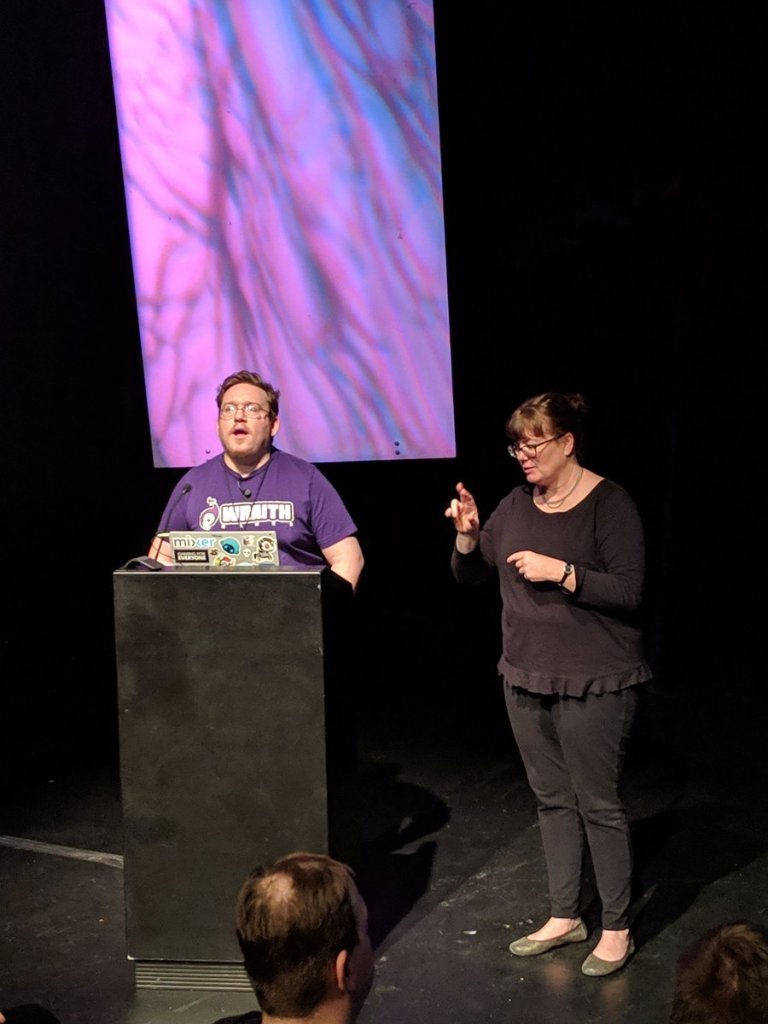
Speaking at GAconf
This was also, unfortunately, a time where many of our long-running peers were closing up shop. People we’d become friends with; colleagues we’d seen at countless events leaving the scene behind them. It felt a bit wrong that we survived and they didn’t.
In 2019, three huge updates rolled in for us. Firstly, we were invited to the Smithsonian’s SAAM Arcade exhibition at the American Art Museum in Washington, DC (I took Lucas), then we were nominated for IndiePrize at the Disneyland Resort Hotel in Anaheim, CA (I took Chris to that one)… just one week apart! Then, we turned right around to co-host the Hamilton Games Festival right in our own hometown of Hamilton, OH alongside several other games event runners we’d befriended throughout the years!

Showing off at SAAM Arcade

Showing off at IndiePrize

Hanging out after The Hamilton Games Festival
Then, two strange, life-changing things would happen to us that very next March. For starters, we were invited in our 3rd year of PAX East to be part of the prestigious IndieMEGABOOTH. Doing MagFest (3 times), GameMasters, GAconf, SAAM Arcade, IndiePrize, and the other two times we did PAX East were HUGE but this was NEXT LEVEL!

Showing of at IndieMEGABOOTH
Secondly, as we were on the showroom floor March of 2020… the world ended.
. . .
As we were in line for lunch our phones started to go off as GDC, E3, Gamescom, and others cancelled their in-person events, right as we were surrounded by 75k nerds in a place no larger than an airport. Luckily, no one at that PAX East caught it, but the convention down the street did have confirmed cases. We dodged a bullet!
What can I say about the pandemic that hasn’t already been said? Needless to say, the world changed. And, in most ways for the worse (at least in the short term), Wraith changed too.
During the pandemic, Mark left us. I don’t want to get into the specifics, but it was pretty ugly. Sadly, with Lucas taking over as lead programmer, with new programmer Nack being hired around that time, literally none of Mark’s code was usable. We had to start over. Again.
Pretty obviously, this was a HUGE setback. That version of the game had 25 Challenge/Plus modes, all 5 difficulties, all 300 Puzzles and the Puzzle Maker, 8-player local multiplayer, bots, a bunch of the options… it was a rough loss. However, the game was unpolished, poorly optimized, and just wasn’t fitting the team’s vision anyway (which was part of the reason we parted with Mark in the first place).
On top of that, with us being unable to use the studio during the pandemic, and the owners of the building (the city government) actively selling it to a hotel chain, we had to leave our in-progress studio behind.
You know the ending of Empire Strikes Back? Yeah, it all felt something like that.
There was SO much to move out. A whole 2000 sq/ft studio to drag out and put into storage.

Moving out: putting everything in one room

Moving out: it’s all gone

Moving out: packing the studio for move-out
Nack only lasted a few months, leaving Lucas as the solo programmer yet again. Thankfully, Chris had joined our team full-time after graduating, so we set out to work from home… then later, in his living room.

Working in Chris’ apartment
That, uh, wasn’t going to work.
Near the end of the pandemic we decided to start looking for a new studio space. This was a really strange time. About every couple weeks we spent nearly a whole work day looking at local properties. However, since most events were still closed (and many actually died outright) it’s not like we were traveling or prepping for the 15 events a year we did since 2015.
Oh, and Lance had a baby (well, his wife did). So he bowed out to focus on the adventure of fatherhood. Then, shortly after, we lost Natalie as well. We did, however, pick up Anthony Donnelly (Lucas’ brother) for our fledgling tabletop division. This left us with me, Kristy, Thorne, Stevie, Adam, Lucas, Chris, and Anthony (and, of course, Glenn as our frequent collaborating musician). The final roster, at least for now!

The current roster!
This puts us pretty much to the last time we had a blog post about things that weren’t strictly Collapsus. Actually that was the IndieMEGABOOTH post right at the start of the pandemic.

The IndieMEGABOOTH blog post title card
While a LOT was happening, because of the pandemic with its working from home, lack of events, and low morale, it didn’t seem pressing to talk about anything other than Collapsus updates (and even those were slow-going). Then, once we started doing events again and getting a new studio space, it never felt right to start the blog back up. Still doesn’t really.

Collapsus NOW!
Here’s a snapshot into everything in the 5-ish year span for you, though:
Firstly, our buddy Griffin (remember him?) opened up a clothing store called “4th Place Co.”, which, through the pandemic became the home of the 3rd official Wraith Store as well. However, all good things must come to an end, and that store, too, closed after just a couple years of operation (don’t worry, we’re working on number 4)!
Then, more importantly, we found Studio 2.0 at a place 3 blocks from the old one in a co-working space called “The Benison”. It was about the size of the single office start of Studio 1.0, but the rent was the same as the full-size 1.0! Yikes! It was a really nice little space though, and we figured we could just have me, Chris, and Lucas (the core Collapsus dev team) use that space and use the shared conference room for everything else.

Moving into Studio 2.0

Painting Studio 2.0

More painting!
That, uh, didn’t work either.
For starters, we brought on a new intern, Sam, to work with us. That already meant we had 4 people in ~200 sq/ft. Not great. However, since it was such a small space, it did allow us to really upgrade the tech we used as well as get the style just right. Unlike Studio 1.0, there was no bickering about what we wanted. We all just, well, agreed! Even though it was tiny, it looked nice and we were running better than ever as a unit.

Studio 2.0!

And the other side!
Oh, as a brief aside, Kristy and I were hit by a car around move-in time. Don’t worry, we got better, but I was in a wheelchair for a bit during the decorating and painting of Studio 2.0.
Anyway, the team running better than ever actually led to a second issue, however. Remember how, all the way back at the start of this story Wraith got its name from D&D? Well, dating back those 20 years, I (and many other Wraith members former and current) have actually been playing the same weekly D&D game (seriously)!
Well, not quite. Technically, since 2015 (the last decade) we transferred our game to a custom tabletop system we’d been tooling around with. In 2019, we were actually able to playtest it at The Hamilton Games Festival… and it was a HIT! So, we started devoting serious dev time to it (which is why we brought Anthony on to be part of our new tabletop division). He, along with other members not directly working on Collapsus, have been working on TOME (the name of the tabletop RPG is “TOME”) along with a couple other surprise projects we may or may not announce down the road.

Chris working in 2.0

Lucas working in 2.0
However, that made it really hard to use the tiny new space. There was a third, larger issue, though: an issue of “structure”. From the start of Wraith back in 2005 to when we got our first EIN and proper domain name back in 2007, Wraith was a “sole proprietorship”. A company “owned” by 1 person. That person was me. Technically we all made decisions democratically, but, on paper, I was the “owner”. Then, in 2015, when we got our first studio space and did our big rebrand, we became an LLC owned, again, by me. I actually hated this. In my mind, this “company” was a democracy. I was intrigued by co-ops and wanted to run Wraith like a co-op, but, being honest, we didn’t have a lot of that formal structure. We did alright, though. Funnily enough, some team members really hated the way we ran it. They wanted a traditional “boss” and hierarchy. About three members mentioned in the story thus far left for that reason specifically. Not going to say who, though. No, in 2023, we made the decision that we were going to completely restructure. Instead of being a sole proprietorship or even an LLC, we would take the leap and become a true, right-proper co-op (or rather, “collective”, which is a completely flat co-op with literally no bosses at all). It wasn’t a problem for us because, to use the words of a friend and former Wraith team member, we had already “gotten the wrong people off the bus, and the right people on the bus” a long time ago. For the last 20 years, we were run democratically, for the past 10 it was a core part of our identity, and for the last 5 everyone was 100% sure they were ready to not just be a team member, but also a co-owner at Wraith Games. One problem then. We’re gonna need a bigger boat. That got us searching for a larger studio space. Funnily enough, it was the place we called before grabbing Studio 2.0, but they hadn’t called us back. 1 year later, on a whim, I called them first and got an answer. We’re talking 1000 sq/ft (half the size of the full Studio 1.0, but that was always too much room anyway but it was 5x the size of 2.0) and the same price as the other two had been! It was a Goldilocks fit! Also, it was in the same kind of historic building like in 1.0, and was only 2 blocks from both 1.0 & 2.0! It was absolutely amazing.
However, we had to remodel it.

Touring Studio 3.0

Taking notes!
We toured it in October 2024, moved in in January 2025, and put the finishing touches on it (at least so far) in July 2025! Just about 6 months from “barely move-in ready” to our DREAM studio space!

Chris painting the mural

Thorne painting the ceiling

Chris assembling the monitors

Kristy painting the ceiling

Anthony, Stevie’s wife Mandy, and Cody working on the break room

Lucas installing a doorknob

This was a LOT

Chris & Adam assembling a shelf

Our friend Bayann painting

Nat & Adam painting

Everyone coming together to get things done!

One view of the Studio 3.0 Bullpen

Another view of the 3.0 Bullpen
3.0 is amazing! While just a bullpen and a break room, the bullpen is divided into a conference area and the main workspace. The break room has a sofa, TV, and kitchenette. The best part? We decorated the bullpen in the same style as Studio 2.0, with its purple mountains (a motif that itself was already taken from Studio 1.0’s unfinished grey mountains, themselves taken from Loading Ready Run’s original Checkpoint set).

LLR’s old Checkpoint set
The break room, on the other hand, uses Studio 1.0’s first office as inspiration, down to the orange accents, and charcoal & French silver walls. In fact, the chairs are actually from 1.0 but never made it over to 2.0, and we used the exact colors of paint throughout both rooms!

A view of the break room in Studio 3.0

Another view of the break room
Additionally, while Studio 2.0 didn’t have windows, we used black roller shades inspired by Stevie’s office at 1.0, and the break room uses orange roller shades. This was a touch planned for Studio 1.0, but we couldn’t afford custom shades at the time. Those were inspired by the ones at Bossa Studios in the UK.

Bossa Game Studios' roller shades
Every little detail is something invoking our past and guiding us to the future. Trophies, books written by and games made by friends throughout the years, gifts from our friends in the industry… it’s all there.

Our shelf and collection from 20 years of dev
Plus, this studio has a finished mural! Not the one planned for 1.0, but, while looking for a suitable 2.0, we nearly closed on a space that fell through at the last minute. That had gotten far enough where we had made mockups for the space. Including a cool mural Chris designed! With just a couple modifications, it was the perfect fit for 3.0!

The new mural
Not only that, but we began going back to events, like another trip to PAX East our our first time at Momocon! This was also a time where we pushed harder than ever to make bigger and better Collapsus builds (even if that meant it took longer between updates).
Starting in 2025, we partnered with the Hamilton Community Foundation to create a tax-deductible non-profit fund to further our goals (you can find that HERE). We also began a program called “Un-Junk the Block” where we get together 3 times a year to grill out and clean up the litter here in the Downtown/CBD neighborhood of Hamilton!

Wraith and friends at Un-Junk the Block!
Plus, we were able to unveil the start of development on a project we conceptualized all the way back in 2007. Caveworm: a multiplayer infinite runner using real claymation models! We had shown off some concept art as early as a few years ago, and we had mentioned it over the years in conversations at events, but this marks Caveworm finally leaving preproduction and entering real production thanks to Chris and our intern, Olivia!

Olivia working on claymation models for Caveworm!
We may have been a bit radio silent (well, on here at least. We do have a Discord and are very active on BlueSky) but I hope you can see these last 5 years have been a LOT of progress exactly to where we want to be!
So, that’s the last 20 years. At least what I can remember and edited in a way that was at least semi-digestible (maybe?).

The Wraith team along with our friend Griffin and my brother Cody bonding (with swords)
We hope long-time fans and friends can appreciate seeing this journey all in one place and that new ones can look at all the crazy ups and downs of our indie game development journey. We started as a group of friends with the goal “hey, let’s make a game” and, well, that’s where we are now, too, huh? Maybe some different friends, different places in our lives, and the why that drives us may be different, but one thing never changes…
We’re still working on Collapsus after 20 years!
Good night everybody! More to come in the New Year (but don’t hold your breath for regular blog posts).


Comments